Names That Mean Fake
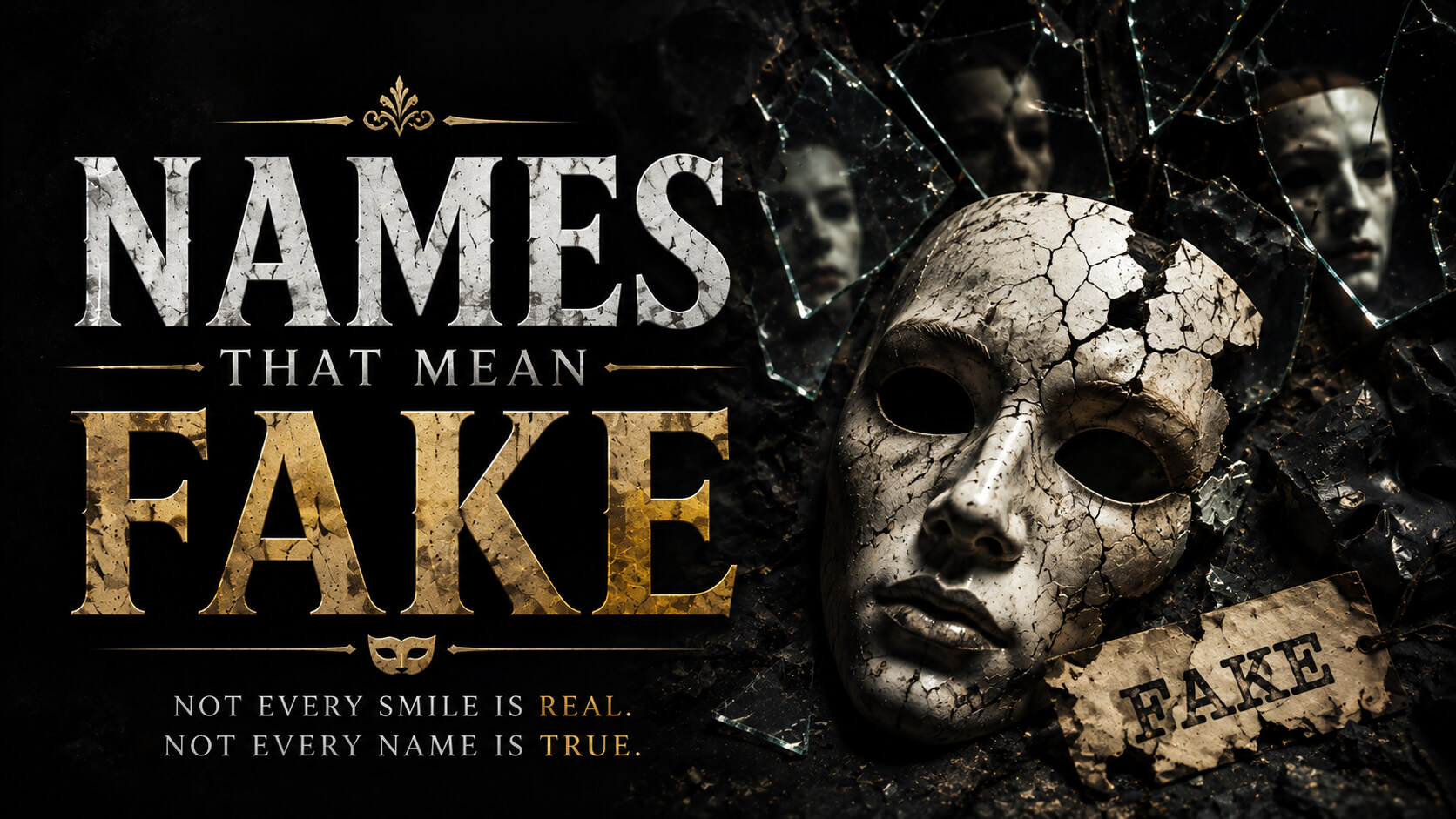
I’ve always been fascinated by names that carry a shadow of meaning behind them. Not every name has to mean “brave” or “beautiful” — some carry the idea of illusion, disguise, mimicry, or something that only looks real. I put together this list for writers, gamers, parents who love unusual meanings, and anyone curious about the language of pretending. Let’s dig in.
What Are Names That Mean Fake?
I like to think of these as “mirror names.” They come from words tied to illusion, mimicry, disguise, mirage, or artificiality across different languages. Some are ancient words for shadow and reflection, others are modern coinages built from roots like “pseudo” or “counterfeit.” None of them are meant as insults — in many cultures, “illusion” and “mystery” are seen as poetic, not negative.
Boy Names That Mean Fake
I find boy names in this theme often lean toward mystery and shadow rather than deceit.
- Pseudonym — a false or invented name
- Mirage — an illusion, often desert-based
- Sham — something not genuine
- Faux — French for “false”
- Mimic — one who imitates
- Doppel — short form of doppelganger, a double
- Shadow — an unreal copy of form
- Illus — rooted in “illusion”
- Cipher — a hidden or masked figure
- Glimmer — a false, fleeting light
- Wraith — a ghostly copy of a person
- Simo — from “simulate”
- Veil — something that hides the truth
- Ashen — pale, unreal appearance
- Ersatz — a substitute, artificial version
- Decoy — something made to mislead
- Guise — a false appearance
- Ruse — a trick or deception
- Feint — a false move
- Counterfeit — imitation passed as real
- Camouflet — hidden or disguised
- Phantom — an illusionary figure
- Trompe — from “trompe-l’œil,” a visual trick
- Simulacrum — an image or representation of something
- Chimeric — imaginary, unreal
- Specious — deceptively attractive but false
- Hollow — appears full but isn’t
- Gilt — surface shine hiding the real material beneath
Girl Names That Mean Fake
Girl names on this theme often sound softer, tied to mirrors, veils, and mist.
- Illusia — a poetic coinage from “illusion”
- Mirela — echoes “mirage” and “mirror”
- Veila — inspired by “veil”
- Sirena — linked to sirens, who lure with false songs
- Fantina — rooted in “fantasy,” the unreal
- Chimera — a mythical, unreal creature
- Ombretta — Italian-inspired, meaning “little shadow”
- Nebula — a hazy, indistinct form
- Glamour — originally meant an illusion or magic spell
- Elara — sound-alike for “ethereal,” not fully real
- Maskara — playing on “mask”
- Faye — from “fay,” relating to enchantment and illusion
- Trickara — coined from “trick”
- Wisp — a faint, unreal glow
- Seraphine — deceptively angelic sound, often used ironically for illusion
- Sable — a shadowy, dark disguise
- Miragea — feminized “mirage”
- Ashley (folk meaning) — “ash,” a pale copy of fire
- Delusia — from “delusion”
- Reverie — a daydream, not reality
- Ondine — a water-spirit tied to illusion in folklore
- Phantasma — from “phantasm,” a false vision
- Vespera — twilight, when things look unreal
- Cloudia — coined for something not solid
- Echo — a repeated, unreal copy of sound
- Simone (folk play) — echoes “simulate”
- Luna Noir — moonlight, deceptive and dim
- Camilla (poetic use) — associated in some tales with disguise
Unisex Names That Mean Fake
These work for any gender and tend to be short, modern, and symbolic.
- Cipher
- Echo
- Sham
- Faux
- Mirage
- Wraith
- Ruse
- Guise
- Phantom
- Ashen
- Vale (echoing “veil”)
- Shade
- Ghost
- Mimic
- Decoy
- Blur
- Static
- Gloss
- Rumor
- Myth
- Illusion (as a full given name in modern naming trends)
- Trick
- Sly
- Feint
- Sable
- Glint
- Hollow
- Reflect
- Doubt
- Facade
Last Names (Surnames) That Mean Fake
Surnames tied to this meaning often come from old trade or nickname origins for tricksters, forgers, or actors.
- Falso — Italian/Spanish root, “false”
- Faussier — French, tied to “faux”
- Truong (folk gloss) — used in some naming lists for “imitation”
- Mockler — English occupational-style surname, “one who mocks/imitates”
- Sham — used as a surname in some regions, tied to “false”
- Ganef — Yiddish-origin surname base meaning “thief/trickster”
- Falsone — Italian surname, from “falso”
- Ffaux — stylized French-rooted surname
- Loki-son — modern coinage from the trickster god Loki
- Trickett — English surname, folk-linked to “trick”
- Deceivers (occupational nickname surname, historical)
- Mummer — English, from actors who wore masks
- Faker — modern occupational-style surname
- Larkin (folk play) — associated in slang with playful deception
- Cozener — old English word for a swindler
- Guiler — from “guile”
- Fabler — teller of fables/untruths
- Falsifier — modern coinage
- Sophist — Greek-rooted, one who argues cleverly but falsely
- Impostore — Italian-style, “impostor”
- Charlatan — French-origin word for a fraud
- Mystifier — one who creates illusion
- Bluffington — playful English-style surname
- Feigner — from “feign”
- Masquer — rooted in “masquerade”
- Simulan — coined from “simulate”
- Glamoure — old spelling tied to illusion
- Trompeur — French for “deceiver”
Baby Names That Mean Fake
I’d lean toward the softer, prettier-sounding ones here for a baby name list.
- Faye
- Elara
- Mira (folk-linked to “mirage”)
- Ondine
- Seraphine
- Luna
- Vale
- Wisp
- Echo
- Glimmer
- Nova (illusion of light from a distant star)
- Cloudia
- Reverie
- Sable
- Vesper
- Chimera (softened as “Kira” in modern use)
- Aria (folk tie to “air,” insubstantial)
- Misty
- Halo (a ring of light, an optical effect)
- Prism (light bent and altered)
- Opal (a stone known for shifting, illusory colors)
- Nixie — water-spirit name tied to illusion
- Fable
- Myth
- Glitter
- Shimmer
- Willow (folk-linked to “wisp” and will-o’-the-wisp)
Cute Names That Mean Fake
- Fibby — playful take on “fib”
- Trixie — rooted in “trick”
- Mira
- Glimmer
- Sparkle (illusion of value, like fool’s gold)
- Wispy
- Foxy (foxes are folk symbols of trickery)
- Puckle — from Puck, the trickster sprite
- Loki (playful, from the trickster god)
- Bluffy
- Shady
- Misty
- Ghosty
- Fauxie — cute spin on “faux”
- Mocky
- Trickee
- Sly
- Elfie (elves are folklore tricksters)
- Pixie (mischief and illusion in folklore)
- Charmy — tied to “charm,” a spell that alters perception
- Glossy
- Twinkle (a shimmer that isn’t solid)
- Dazzle
- Illusia
- Cammie (short for camouflage)
- Maskie
- Sirenna
- Riddle
- Puzzlee
Cute Girl Names That Mean Fake
- Trixie
- Mira
- Faye
- Pixie
- Glimmer
- Sparkle
- Twinkle
- Dazzle
- Wispy
- Misty
- Charmy
- Elfie
- Sirenna
- Nixie
- Opaline — from “opal,” shifting color
- Glossy
- Vesper
- Luna
- Willow
- Rosalind (folk-linked to disguise in classic literature)
- Viola (a character famous for disguise in “Twelfth Night”)
- Portia (folk-linked to disguise in classic drama)
- Cinder (as in Cinderella, hidden true identity)
- Bell (a “belle” behind a mask, ballroom disguise tradition)
- Marina (illusion of the sea’s surface)
- Coral (looks like stone, is actually alive — a natural “fake-out”)
- Foxglove — foxes as trickster symbols
- Rainey — refers to a rainbow, an optical illusion
Chinese Names That Mean Fake
- Jiǎ (假) — literally means “false” or “fake”
- Wěi (伪) — means “fake” or “counterfeit”
- Xū (虚) — means “empty” or “illusory”
- Huàn (幻) — means “illusion” or “fantasy”
- Yǐng (影) — means “shadow” or “reflection”
- Mèng (梦) — means “dream,” something unreal
- Piàn (骗) — root meaning “to deceive”
- Zhuāng (装) — means “to pretend” or “disguise”
- Ní (拟) — root for “imitate”
- Fǎng (仿) — means “to imitate/copy”
- Yōu (幽) — means “hidden” or “faint,” ghost-like
- Mí (迷) — means “confused” or “illusory maze”
- Kōng (空) — means “empty,” illusory nature in Buddhist thought
- Yún (云) — clouds, ever-changing and insubstantial
- Wù (雾) — means “mist,” obscuring the real
- Yuè Yǐng (月影) — “moon shadow,” a poetic illusion name
- Huàn Mèng (幻梦) — “illusory dream,” a compound name
- Fú Yún (浮云) — “floating cloud,” symbol of impermanence
- Jìng Huā (镜花) — “mirror flower,” a classical term for illusion
- Shuǐ Yuè (水月) — “moon in water,” classic symbol of unreality
- Xū Yǐng (虚影) — “illusory shadow”
- Méng Lóng (朦胧) — “hazy, blurred”
- Piāo Miǎo (缥缈) — “faint and dreamlike”
- Chán (禅) — Zen concept touching on the illusory nature of the world
- Fàn Yǐng (泛影) — “floating reflection”
- Yǐn Yuē (隐约) — “vague, indistinct”
- Kē Huàn (科幻) — root tied to “fantasy/sci-fi,” the imagined
- Nǐ Xiàng (拟像) — “simulacrum,” a copy of a copy
Egyptian Names That Mean Fake
- Shesh — an ancient term used for imitation materials in craftwork
- Kha-Ib — a play on “shadow of the heart,” representing an unreal double
- Sheny — coined to reflect “shadow self” in Egyptian soul concepts
- Akhu — tied to the “spirit” that isn’t the physical body
- Ba-Sen — referencing the Ba spirit, a symbolic, non-physical double
- Ka-Nefer — the Ka was believed to be a spiritual double of a person
- Menes-Sha — a coined name meaning “shadow of the founder”
- Tut-Ombra — a blended coinage meaning “shadow king”
- Iset-Vel — inspired by Isis and “veil,” concealment
- Sekhem-Shadow — power hidden behind illusion
- Ren-Kha — the “name” and “spirit double” concept combined
- Nun-Mirage — referencing Nun, the primordial waters, source of illusionary forms
- Anубis-Mask — Anubis, linked with masks and funerary disguise
- Hathor-Veil — Hathor imagery often included veiled or masked ritual dance
- Osiris-Shade — Osiris as a spirit-double after death
- Ma’at-False — contrasted directly against Ma’at, the goddess of truth
- Thoth-Scribe-Fake — Thoth as scribe, associated with recorded (sometimes altered) truths
- Sobek-Mirror — crocodile god tied to river reflections
- Bastet-Guise — cat goddess linked with shapeshifting tales
- Set-Trick — Set, the trickster god of chaos and deception
- Wadjet-Illusion — protective eye symbol, sometimes tied to visual tricks
- Khepri-Shift — the scarab god of transformation and change of form
- Nile-Mirage — the river’s shimmering, illusory surface
- Sphinx-Riddle — the Sphinx, famous for riddles and hidden truths
- Amun-Hidden — Amun’s name itself translates to “the hidden one”
- Ptah-Craft — god of craftsmen, who “fake” materials into art
- Serqet-Sting — hidden danger behind a calm appearance
- Nephthys-Shadow — goddess linked with the unseen and hidden realms
French Names That Mean Fake
- Faux — “false,” the root word itself
- Fausse — feminine form of “false”
- Illusoire — “illusory”
- Mirage — “mirage,” directly borrowed into English too
- Semblant — “appearance” or “seeming”
- Trompeur — “deceiver”
- Trompeuse — feminine form of “deceiver”
- Feinte — “feint” or “fake move”
- Contrefaçon — “counterfeit”
- Postiche — “fake” or “artificial,” often used for wigs
- Simulacre — “simulacrum,” a false copy
- Chimère — “chimera,” a fantastical illusion
- Ombre — “shadow”
- Reflet — “reflection”
- Voile — “veil”
- Ruse — “ruse” or “trick,” used in English too
- Duperie — “deception”
- Frime — informal French for “fake show” or “bluff”
- Toc — slang French for “fake” or “cheap imitation”
- Mystification — “mystification,” an elaborate deception
- Camouflage — “camouflage,” from French origin
- Artifice — “artifice,” a clever trick
- Fantasme — “fantasy” or “phantasm”
- Songe — “dream,” the unreal
- Brume — “mist,” obscuring reality
- Leurre — “lure” or “decoy”
- Deguisement — “disguise”
- Masque — “mask”
Greek Names That Mean Fake
- Pseudos (Ψεῦδος) — the root word for “false,” origin of “pseudo”
- Apate — the Greek goddess/personification of deceit
- Dolos — the Greek spirit of trickery and cunning
- Eidolon — a phantom or spectral image, a copy without substance
- Skia — Greek for “shadow”
- Phasma — Greek for “phantom” or “apparition”
- Mimesis — the concept of imitation or representation
- Sophistria — feminized coinage from “sophistry,” clever false argument
- Chimaira — origin of “chimera,” a monstrous illusion
- Oneiros — the god/personification of dreams, the unreal
- Nephele — a cloud-woman created as a false Hera in myth
- Kore-Skia — “shadow maiden,” a poetic coinage
- Plasma — from “plassein,” to mold or shape artificially
- Mythos — “myth,” a constructed story, not literal fact
- Phantasia — Greek root of “fantasy,” mental image not reality
- Enantios — “opposite” or “contrary,” playing against truth
- Antiphasis — the concept of contradiction, opposing what’s real
- Iris-Skia — Iris the rainbow goddess, an optical phenomenon
- Morphe-Pseudes — “false form,” a coined compound
- Aphanes — “unseen” or “invisible,” hidden from truth
- Kenos — Greek for “empty” or “void”
- Doxa — “opinion” or “appearance” as opposed to true knowledge
- Skiagraphia — “shadow-painting,” an ancient illusionistic art technique
- Automatos-Pseudo — “self-moving fake,” referencing early Greek automata
- Narkissos — Narcissus, fooled by his own reflection
- Hypnos-Oneiros — sleep and dream, both states of unreality
- Trope — Greek-origin word for a figurative, non-literal turn of meaning
- Pseftis (Ψεύτης) — modern Greek for “liar”
Italian Names That Mean Fake
- Falso — “false,” masculine form
- Falsa — “false,” feminine form
- Finto — “fake” or “pretend,” masculine
- Finta — “fake” or “pretend,” feminine
- Illusorio — “illusory”
- Miraggio — “mirage”
- Contraffatto — “counterfeit”
- Simulato — “simulated”
- Ombra — “shadow”
- Riflesso — “reflection”
- Velo — “veil”
- Inganno — “deception”
- Truffa — “scam” or “fraud”
- Fantasma — “ghost” or “phantom”
- Maschera — “mask”
- Trucco — “trick” or “makeup trick”
- Bugia — “lie”
- Apparenza — “appearance,” as opposed to reality
- Sogno — “dream”
- Nebbia — “fog,” obscuring the truth
- Camuffato — “camouflaged”
- Posticcio — “fake” or “artificial,” used for hairpieces
- Doppio — “double,” a false copy
- Specchio-Falso — “false mirror,” a coined compound
- Artificio — “artifice”
- Chimera — “chimera,” borrowed directly
- Mistificazione — “mystification”
- Sembianza — “semblance” or “likeness”
Japanese Names That Mean Fake
- Uso (嘘) — means “lie” or “falsehood”
- Nise (偽) — means “fake” or “imitation”
- Maboroshi (幻) — means “phantom” or “illusion”
- Kage (影) — means “shadow”
- Yume (夢) — means “dream”
- Utsutsu (現) — ironically, “reality,” often contrasted with illusion in poetry
- Kasumi (霞) — means “mist” or “haze”
- Kyozo (虚像) — means “false image” or “virtual image”
- Gisou (偽装) — means “disguise” or “camouflage”
- Itsuwari (偽り) — means “falsehood” or “deceit”
- Genei (幻影) — means “phantom” or “illusion” (compound)
- Mizukagami (水鏡) — means “water mirror,” a reflective illusion
- Sora-Ne (空音) — coined, “empty sound,” a hollow imitation
- Karisome (仮初め) — means “temporary” or “fleeting/false”
- Ninjou-Gisei — coined, tied to disguise traditions of ninja
- Bakeru (化ける) root — the verb “to transform/disguise oneself”
- Yokai-Kage — spirit-shadow, referencing shape-shifting yokai folklore
- Tsukimi-Yume — “moon-viewing dream,” poetic illusion imagery
- Utakata (泡沫) — means “bubble” or “ephemeral, fleeting thing”
- Mayoi (迷い) — means “confusion” or “illusion of the mind”
- Sasayaki-Uso — “whispered lie,” a coined poetic name
- Kagerou (陽炎) — means “heat haze” or “shimmering mirage”
- Hikage (日陰) — means “shade,” something not in true light
- Kyomu (虚無) — means “nothingness” or “void,” philosophical illusion
- Souzou-Zou — coined from “imagination” and “image/statue”
- Fugainai-Kage — coined, “unworthy shadow”
- Nisemono (偽物) — literally means “a fake” or “counterfeit item”
- Karagoto (空言) — means “empty words” or “lies”
Latin Names That Mean Fake
- Falsus — “false,” the direct Latin root of the English word
- Falsa — feminine form of “false”
- Fictus — “feigned” or “fictitious,” root of “fiction”
- Simulatus — “simulated” or “pretended”
- Imago — “image” or “likeness,” not the real thing
- Umbra — “shadow”
- Illusio — “illusion” itself, direct Latin root
- Vanus — “empty” or “vain,” lacking substance
- Fucatus — “disguised” or “painted over”
- Adumbratus — “shadowed” or “sketched falsely”
- Simulacrum — “image” or “phantom likeness”
- Species Falsa — “false appearance,” a compound term
- Mendax — “lying” or “false,” root of “mendacious”
- Praetextus — “pretext,” a false reason
- Specter — related to “spectrum,” an apparition
- Ludificatio — “deception” or “mockery”
- Pigmentum Falsum — “false coloring,” a coined phrase
- Effigies — “effigy,” a crafted likeness, not the real being
- Persona — originally “mask” worn by actors
- Deceptio — “deception,” the direct Latin root
- Praestigiae — “tricks” or “illusions,” root of “prestige”
- Nebula — “mist” or “cloud,” obscuring
- Umbratilis — “shadowy” or “unreal”
- Larva — originally meant “mask” or “ghost” in Latin
- Fantasma — Latin-Greek hybrid for “phantom”
- Vultus Falsus — “false face,” a coined phrase
- Ars Fallendi — “the art of deceiving,” a coined phrase
- Reflexus — “reflection,” root of the English word
Roman Names That Mean Fake
- Falsarius — a Roman legal term for “forger” or “counterfeiter”
- Larvatus — “masked,” from “larva,” the Roman word for a mask
- Simulator — “one who simulates or pretends,” direct Roman root
- Umbra-Ludens — “playing shadow,” a coined Roman-style name
- Persona-Vera — “true mask,” an ironic coined compound
- Mendacius — Roman-style extension of “mendax,” liar
- Praestigiator — a Roman term for a conjurer or illusionist
- Fictor — “one who fashions or fabricates”
- Species-Ficta — “fabricated appearance”
- Fucatus-Rex — coined, “the disguised king”
- Imago-Falsa — “false image,” a coined compound
- Deceptor — “deceiver,” direct Roman root
- Adumbra — coined feminine from “adumbratus,” shadowed
- Effigia — feminine coinage from “effigies”
- Vanitas — “vanity” or “emptiness,” a favorite Roman art theme
- Simulacra-Regis — “the king’s phantom image”
- Fallacia — “fallacy” or “trick,” Roman legal/rhetorical term
- Ars Simulandi — “the art of pretending,” coined phrase-name
- Praetexta-Falsa — “false pretext,” coined compound
- Numen-Umbrae — “spirit of the shadow,” coined mythic-style name
- Gladiator-Persona — the mask-like personas gladiators sometimes fought under
- Triclinium-Illusio — coined, referencing decorative illusion art in Roman dining rooms
- Mosaicus-Falsus — coined, referencing trompe-l’œil mosaic art
- Theatri-Larva — “theater mask,” referencing Roman drama
- Speculum-Falsum — “false mirror”
- Fumus — “smoke,” Roman metaphor for insubstantial things
- Nebulo — actually a real Roman word meaning “worthless, shadowy person”
- Vox-Falsa — “false voice”
Turkish Names That Mean Fake
- Sahte — the direct Turkish word for “fake” or “counterfeit”
- Yalan — means “lie” or “falsehood”
- Hayal — means “dream” or “illusion”
- Gölge — means “shadow”
- Aldatıcı — means “deceptive” or “misleading”
- Serap — means “mirage,” a well-known Turkish given name
- Yanılsama — means “illusion” or “optical trick”
- Taklit — means “imitation” or “copy”
- Maske — the Turkish word for “mask”
- Düzmece — means “fabricated” or “fake”
- Gerçek Dışı — means “unreal,” literally “outside of real”
- Hile — means “trick” or “ruse”
- Sanal — means “virtual,” not physically real
- Kurgu — means “fiction” or “construct”
- Yansıma — means “reflection”
- Boş — means “empty” or “hollow”
- Uydurma — means “made-up” or “fabricated”
- Puslu — means “hazy” or “foggy”
- Efsun — means “spell” or “enchantment,” altering perception
- Görüntü — means “image” or “appearance”
- Şeytan Aldatması — a folk phrase meaning “the devil’s deception,” used for mirages
- Rüya — means “dream”
- Sis — means “fog” or “mist”
- Yalancı — means “liar”
- Numara — colloquially used to mean “an act” or “a fake show”
- Fani — means “transient” or “unreal/impermanent”
- Baştan Çıkarma — means “seduction/deception,” a lure
- Serapgül — a coined compound of “serap” (mirage) and “gül” (rose)
Urdu Names That Mean Fake
- Jhoothi — means “false” or “lying,” feminine form
- Jhoota — means “false” or “lying,” masculine form
- Farebi — means “deceptive” or “cunning”
- Fareb — means “deception” or “trick”
- Sarab — means “mirage,” a poetic and commonly used term in Urdu poetry
- Khayali — means “imaginary” or “illusory”
- Naqli — means “fake” or “imitation,” commonly used for counterfeit goods
- Dhoka — means “betrayal” or “deception”
- Saya — means “shadow”
- Aks — means “reflection”
- Wahmi — means “illusory” or “based on false belief”
- Farzi — means “fake” or “fabricated,” widely used in everyday Urdu
- Bharam — means “illusion” or “misconception”
- Zahiri — means “apparent” or “on the surface only”
- Nakli Chehra — means “fake face,” a poetic compound
- Khwab — means “dream”
- Dhundhla — means “hazy” or “blurred”
- Chal — means “trick” or “move,” often used for deceptive tactics
- Aitbaar-Shikan — coined, “trust-breaker”
- Purfareb — means “full of deception,” a poetic intensifier
- Mukhauta — means “mask”
- Nazar Ka Dhoka — a phrase meaning “trick of the eye,” an optical illusion
- Zaahiri Roop — means “outward form,” implying it’s not the true self
- Bewajah — coined loosely as “without real cause,” an unreal pretext
- Fani — means “temporary” or “mortal/unreal in the long run”
- Chhal-Kapat — means “deceit and fraud,” a common compound phrase
- Aabroo Ka Parda — coined, “veil of honor,” concealment
- Sarabi — feminine poetic form derived from “sarab” (mirage)
Quran-Inspired Arabic Names Tied to Illusion
I want to be careful and respectful here, so instead of framing sacred names as “fake,” I’m listing real Arabic/Quranic vocabulary connected to concepts like mirage, shadow, and appearance — themes the Quran itself uses poetically.
- Sarab (سراب) — “mirage,” a term used in the Quran to describe illusions that seem real from a distance
- Zill (ظل) — “shadow”
- Khayal (خيال) — “imagination” or “shadow-image”
- Wahm (وهم) — “illusion” or “false assumption”
- Ghurur (غرور) — “delusion” or “vain illusion,” used in the Quran regarding worldly deception
- Zahir (ظاهر) — “the apparent” or “the outward,” as opposed to what is hidden and true
- Batil (باطل) — “falsehood” or “vanity,” often contrasted with “haqq” (truth)
- Talbis (تلبیس) — “disguise” or “confusion of truth and falsehood”
- Iftira (افتراء) — “fabrication” or “invented falsehood”
- Kadhib (كذب) — “lying” or “falsehood”
- Mithl (مثل) — “likeness” or “parable/image,” a representation
- Hulm (حلم) — “dream”
- Ghaib (غيب) — “the unseen,” beyond apparent reality
- Sahab (سحاب) — “cloud,” an ever-shifting, insubstantial form
- Dukhan (دخان) — “smoke,” insubstantial and fleeting
Different Names That Mean Fake
- Simulare (invented, Latin-flavored) — “to imitate”
- Feindra (coined) — playing on “feint”
- Ilusora (coined) — Spanish/Latin-flavored, “illusion-bearer”
- Verrat (German) — actually means “betrayal,” close to deception in theme
- Falsk (Swedish/Danish/Norwegian) — literally means “false”
- Vals (Dutch) — means “false”
- Falso (Spanish/Portuguese) — means “false”
- Nepravdivý (Czech) — means “untrue”
- Fałszywy (Polish) — means “false”
- Hamis (Finnish) — means “fake” or “sham”
- Sahte (Turkish, repeated for cross-reference) — “fake” -假 (Jiǎ, Chinese, repeated for cross-reference) — “false”
- Meccheu (invented, playful) — coined to sound like “mock”
- Feikur (Icelandic) — means “fake,” borrowed from English
- Ffug (Welsh) — means “fake” or “pretend”
- Bréagach (Irish) — means “false” or “lying”
- Ffuglun (Welsh, compound) — coined-style, “false form”
- Tszevaneh (invented fantasy-style) — coined to sound exotic and mysterious
- Nullus Verus (Latin phrase-name) — “not true,” a coined compound
- Errant (Old French-rooted) — associated with wandering, uncertain truth
- Glamouria (coined) — extending “glamour” as illusion
- Trompette (playful French pun) — sounds like “trompe” (deceive)
- Skygga (Old Norse-rooted) — means “shadow”
- Draumr (Old Norse) — means “dream”
- Villa (Old Norse root, “villr”) — means “to lead astray, deceive”
- Svik (Old Norse/Icelandic) — means “deceit” or “betrayal”
Dark Names That Mean Fake
- Nihil — Latin for “nothing,” a void behind the illusion
- Umbra Mortis — coined, “shadow of death”
- Vacuus — Latin for “empty” or “void”
- Malum Simulacrum — coined, “evil copy”
- Tenebrae — Latin for “darkness”
- Larvatum — coined, “masked one” (dark tone)
- Perfidus — Latin for “treacherous, false”
- Noctis Umbra — coined, “shadow of the night”
- Dolus Malus — Roman legal term for “malicious deceit”
- Spectrum Falsum — coined, “false ghost”
- Kravyad-Kage — coined fantasy-style, “shadow devourer”
- Ombra Nera — Italian, “black shadow”
- Ghul-Nakab — coined, blending “ghoul” and “mask”
- Yami-Uso — Japanese-flavored coined compound, “darkness-lie”
- Mravka Sien — coined Slavic-flavored, “dark shadow”
- Skotos — Greek for “darkness”
- Nyx-Eidolon — coined, blending Nyx (night goddess) and “phantom image”
- Malebranca — coined Italian-flavored, “evil branch/false limb”
- Falsus Rex — coined, “the false king”
- Umbrathorn — coined fantasy name, “shadow of thorn”
- Duskveil — coined, English compound
- Nocturnem Simulacrum — coined, “nightly false image”
- Shadowmask — coined English compound
- Grimfaux — coined, blending “grim” and “faux”
- Wraithkin — coined, “kin of the wraith”
Deep/Meaningful Names That Mean Fake
- Maya (माया) — a rich Sanskrit term meaning “illusion,” especially the illusion of the material world in Hindu philosophy
- Avidya — Sanskrit for “ignorance” or “false perception of reality”
- Samsara-Chhaya — coined, “shadow of the cycle of illusion”
- Anitya — Sanskrit/Buddhist term for “impermanence,” things that seem permanent but aren’t
- Sunyata — Buddhist term for “emptiness,” the illusory nature of fixed selfhood
- Prapancha — Sanskrit for the “illusory manifestation” of the world
- Mithya — Sanskrit for “false” or “illusory”
- Vikalpa — Sanskrit for “false mental construct”
- Rupa-Chhaya — coined, “shadow-form”
- Kenosis — Greek theological term for “self-emptying,” related to appearance versus essence
- Nous-Eidolon — coined, “mind’s phantom”
- Aletheia-Skia — coined, “shadow of truth” (Aletheia meaning truth in Greek)
- Verumbra — coined Latin-style, “truth-shadow,” implying something between real and unreal
- Hyle-Morphe — coined philosophical compound about matter versus false form
- Doxastic — philosophy-rooted term for belief-based (not necessarily true) perception
- Noumenon-Shade — coined, referencing Kantian philosophy’s “thing as it appears” vs. as it is
- Phenomenal-Veil — coined philosophical compound
- Solipsis — coined from “solipsism,” a mind that can’t confirm outside reality
- Existentia-Falsa — coined Latin-style, “false existence”
- Nihila-Verum — coined, “nothing that seems true”
English Names That Mean Fake
- Sham
- Faux
- Fake (used directly as a stylized name in some modern trends)
- Feint
- Bluff
- Decoy
- Guise
- Ruse
- Mimic
- Copycat (informal)
- Counterfeit
- Imposter
- Pretender
- Phony
- Mockup
- Hollow
- Facade
- Veneer
- Gloss
- Glitz
- Tinsel (cheap, shiny imitation of gold)
- Paste (a term for fake gemstones)
- Plastic (slang for fake or superficial)
- Cardboard (slang for something flimsy and unreal)
- Knockoff
Old and Vintage-Style Names That Mean Fake
- Feigned (archaic adjective, “pretended”)
- Dissembler (an old term for someone who hides true feelings)
- Beguile (old English verb, to deceive charmingly)
- Cozen (archaic verb meaning “to trick”)
- Wile (old English noun for a cunning trick)
- Sleight (as in “sleight of hand”)
- Gull (archaic term for both “to deceive” and “a person easily fooled”)
- Chicane (old term for trickery, root of “chicanery”)
- Colour (archaic use, “false colour” meant a deceptive pretext)
- Varnish (old metaphor for a false, glossy covering)
- Tinsel (Victorian-era metaphor for showy but worthless things)
- Mountebank (an old word for a charlatan or fraudulent showman)
- Quacksalver (archaic root of “quack,” a fake healer)
- Humbug (old English term for a hoax or fraud)
- Flimflam (old slang for a deceptive trick)
- Hoodwink (old English verb meaning to deceive)
- Gammon (old British slang for nonsense meant to deceive)
- Bamboozle (old slang for confusing someone with tricks)
- Cant (old term for insincere talk)
- Pretence (older British spelling of “pretense”)
Other Names From Different Cultures That Mean Fake
- Falski (Slavic-style coinage) — echoing “false”
- Lozhny (Russian, ложный) — means “false”
- Fałsz (Polish) — means “falsehood”
- Hazug (Hungarian) — means “liar”
- Kuvia-Vale (Finnish-flavored, “vale” meaning “lie”) — coined compound
- Vale (Finnish) — actually means “lie” or “false” in Finnish
- Onera (Filipino/Tagalog-flavored coinage) — sounds mysterious, tied loosely to disguise themes
- Peke (Māori/Filipino-influenced word forms in some languages relate to “fake” or “pretend”)
- Uwongo (Swahili) — means “lie” or “falsehood”
- Udanganyifu (Swahili) — means “deception”
- Kihaya-Mask (coined East African-flavored compound)
- Dối Trá (Vietnamese) — means “deceitful”
- Giả (Vietnamese) — means “fake” or “artificial”
- Palsu (Indonesian/Malay) — means “fake” or “counterfeit”
- Tiruan (Indonesian/Malay) — means “imitation”
- Kongsong-Ga (Korean-flavored coinage)
- G짜 (Ga-jja, Korean, 가짜) — means “fake” or “counterfeit”
- Geojitmal (Korean, 거짓말) — means “lie”
- Mtoto wa Kivuli (Swahili phrase) — coined, “child of the shadow”
Popular Names That Mean Fake (In Modern Usage)
- Loki — the Norse trickster god, now a very popular modern first name
- Puck — the mischievous sprite from folklore, now used as a stylish short name
- Sly — increasingly used as a modern given name, meaning “cunning”
- Mira — popular baby name, loosely tied to “mirage” in sound
- Nova — trendy modern name, tied to illusion of distant starlight
- Echo — used as a unisex modern baby name
- Luna — extremely popular name, tied to moonlight and its shifting illusions
- Aria — popular modern name, loosely tied to something airy and insubstantial
- Halo — used as a modern stylish name, referring to an optical light effect
- Opal — a popular gemstone name known for shifting colors
- Willow — popular tree-inspired name, folk-linked to “will-o’-the-wisp”
- Iris — popular flower/rainbow-goddess name, tied to optical phenomena
- Misty — a retro-cute name tied to fog and obscured reality
- Sable — a stylish modern name tied to shadow and dark disguise
- Phoenix — popular modern name symbolizing transformation and illusion of death/rebirth
- Raven — popular dark-toned name, folk-tied to trickster bird myths
- Fox — increasingly used as a modern first name; foxes symbolize cunning
- Vesper — trendy modern name meaning “evening,” when shapes blur
- Wren — trendy bird name, small and easily overlooked/hidden
- Blaze — modern name meaning a fire that flares and vanishes
Queen and Royal-Sounding Names That Mean Fake
- Regina Falsa — coined, “the false queen”
- Illusia Regina — coined, “queen of illusion”
- Umbraline — coined regal-sounding name, from “umbra” (shadow)
- Fauxlette — coined, playful royal-sounding name from “faux”
- Miragella — coined regal name from “mirage”
- Sirenna Regis — coined, “the siren queen”
- Vaneska — coined, from “vanity” and royal suffix “-eska”
- Glamourette — coined regal-cute name from “glamour”
- Chimerissa — coined regal-sounding name from “chimera”
- Reinerie — coined, playing on French “reine” (queen) and “rêverie” (dreaming)
- Phantomina — coined regal-sounding name from “phantom”
- Larvina — coined regal name from Latin “larva” (mask)
- Specterine — coined regal name from “specter”
- Ombralia — coined regal name from “ombra” (shadow)
- Delusiana — coined regal name from “delusion”
- Verishka — coined, ironically meaning “seemingly true”
Rare Names That Mean Fake
- Aporia (Greek-rooted) — a state of puzzlement created by contradictory illusions
- Skiagraph (rare, from ancient shadow-painting) — used rarely as a given name
- Nebulon (rare coinage) — from “nebula,” a hazy form
- Adumbral (rare adjective) — meaning “shadowy” or “vaguely outlined”
- Fatuous-styled coinage “Fatua” — root meaning “foolish, unreal”
- Illudere-derived “Illuder” — Latin root meaning “to mock or deceive”
- Simular (rare coinage) — from “simulate”
- Praestige (older spelling of “prestige,” originally meant “illusion/trick”)
- Nihileen (rare coinage) — from “nihil,” nothing behind the appearance
- Umbrata (rare Latin-style feminine) — “shadowed one”
- Vaporel (rare coinage) — from “vapor,” insubstantial
- Glimmeria (rare coinage) — from “glimmer”
- Wraithe (rare stylized spelling of “wraith”)
- Feintara (rare coinage) — from “feint”
- Mendaxia (rare coinage) — from Latin “mendax,” lying
Real (Actual, Documented) Names That Mean Fake
- Sarab — a real given name used in Arabic, Persian, and Turkish-speaking regions, meaning “mirage”
- Maya — a genuinely popular real name across South Asia, meaning “illusion” in Sanskrit (also has other meanings depending on origin)
- Serap — a real, commonly used Turkish given name meaning “mirage”
- Vale — a real Finnish word for “lie,” occasionally seen in wordplay names
- Nisemono — not typically used as a given name, but a real documented Japanese word for “fake” or “counterfeit item”
- Ghurur — a real Arabic word for “delusion,” occasionally used in poetic naming
- Illusion — used as an actual, if unconventional, modern given name in some English-speaking regions
- Mirage — documented as an actual, if rare, given name in modern naming records
Random Names That Mean Fake
- Zynth (invented) — sounds modern and synthetic, tied loosely to “synthetic”
- Vex-Kai (invented) — coined fantasy-style
- Trixara (invented)
- Feyndel (invented)
- Sarabex (invented, blending “sarab” and modern sound)
- Ombreth (invented)
- Glimvex (invented)
- Fauxton (invented)
- Mirandel (invented, echoing “mirage”)
- Shamira (invented, blending “sham” and a common name ending)
- Illumira (invented, blending “illusion” and “mira”)
- Vespren (invented)
- Nocturis (invented)
- Kagemori (invented, Japanese-flavored, blending “kage” shadow and “mori” forest)
- Falsimir (invented, blending “false” and “vladimir”-style ending)
Stylish and Modern Names That Mean Fake
- Zara-Mirage (styled compound)
- Kai Shadow (styled compound)
- Nova Illusion (styled compound)
- Echo Vale
- Luna Faux
- Sable Reign
- Vesper Sly
- Raven Mimic
- Phoenix Guise
- Onyx Wraith
- Storm Glimmer
- Ash Phantom
- Sky Mirage
- Wilder Sham
- River Cipher
Unique Names That Mean Fake
- Kagerou — Japanese for “heat haze” or “shimmering mirage,” rarely used but strikingly unique
- Prapancha — Sanskrit philosophical term for illusion, very rarely used as a name
- Skiagraph — a truly unique, almost unheard-of choice
- Talbis — a distinctive Arabic word meaning “disguise/confusion of truth”
- Adumbral — a rare English adjective, unusual as a first name
- Verumbra — a coined but genuinely unique-sounding blend of “truth” and “shadow”
- Nisemono — bold and unique choice, directly meaning “fake” in Japanese
- Ghurur — a distinctive Arabic-origin option
FAQs About Names That Mean Fake
Are there real baby names that literally mean “fake” or “illusion”?
Yes — names like Sarab (Arabic/Turkish for “mirage”), Maya (Sanskrit for “illusion”), and Serap (Turkish for “mirage”) are real, documented names actually used by people.
Is it a bad idea to name a child something that means “fake”?
Not necessarily — in many cultures, words for “illusion,” “dream,” or “mirage” are considered poetic and mysterious rather than negative.
Why do so many mythological figures have names tied to trickery?
Trickster figures like Loki, Dolos, and Puck appear across cultures because storytellers everywhere have long been fascinated by cleverness, disguise, and deception as narrative themes.
What’s a good short, modern name that means fake?
Echo, Vale, Sly, Cipher, and Nova are all short, modern-sounding options tied loosely to illusion or imitation.
Do Japanese and Chinese cultures have specific words for “fake”?
Yes — Japanese uses “nise” (偽) and “uso” (嘘), while Chinese uses “jiǎ” (假) and “wěi” (伪), all meaning fake or false.
Can “names that mean fake” be used in fiction and games?
Absolutely — many writers and game designers use these meanings for trickster characters, spies, illusionists, or shapeshifter roles.
Final Thoughts
I put this list together because I think words for “illusion” and “disguise” are some of the most poetic in any language — they capture something universally human: the gap between how things look and how they really are. Whether you’re naming a character, a pet, or just love collecting unusual word meanings, I hope this gave you plenty to work with.